There’s a part of my brain that is very impatient.
Is this a genetic thing, an in-built urge to avoid boredom? Is it due to growing up alongside the internet, as the twin notions of convenience and instant gratification truly kicked in? Or do I increasingly feel the steely fingers of time passing over me, never slowing. It’s hard to say.
So anyway, I naturally want quick results, it seems. Which, paradoxically of course, means it’s harder to see things long term sometimes. "Sustained" action can become an aspiration rather than a practicality.
Which is relevant right now. After reading about the concept of Ikigai and the overlap of purpose, skills, and needs, I woke up excited on Monday morning with a few realisations running through my head. There were directions I knew wanted to point and paths I wanted to tread. Everything seemed clearer than before.
And then, as usual, I muddied it up by writing it down 🤣
Actually, no need to be harsh on myself. Rather, just appreciate that writing things down can be a difficult exercise, especially when it comes to trying to communicate difficult stuff to anonymous others. It’s a fool’s game in some ways, but often a worthwhile one, just to get garbled sentences out of the way.
People ask me what I do, and I generally um and er a bit, which I’ve decided isn’t the greatest way to sell your services, or spin your own story. For me, it’s fine, but I’ve known myself for a few years now. Other people, well, haven’t. Seems fair.
And when I come to answer, I also tend to break it down into two parts – what I do (or have done), and what I would like to do. Liminal transition life is full of ambiguity like this.
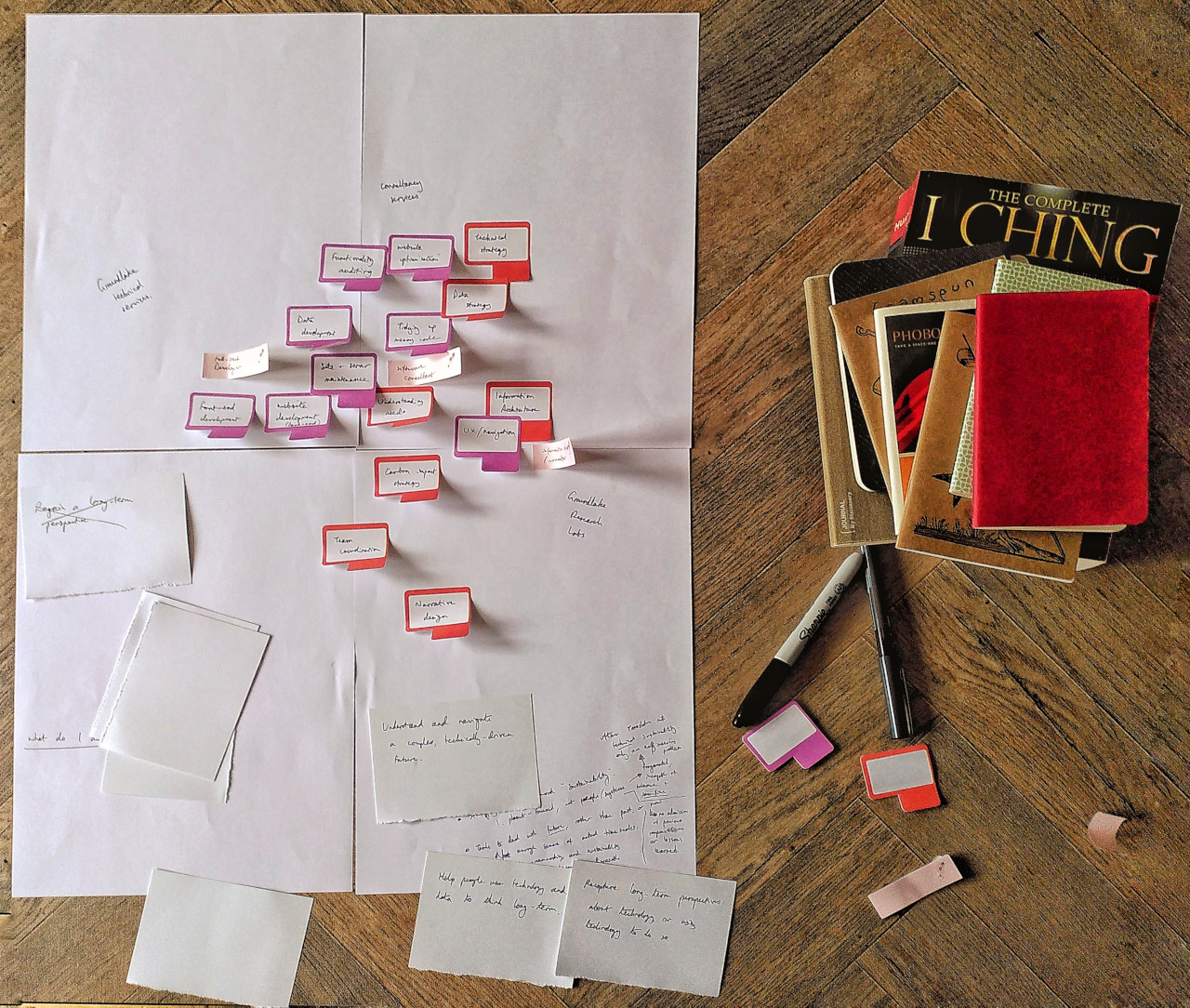
So Monday morning, with the treat of a decent coffee, I wrote down what my skills and interests were – one per tiny post-it – and arranged them very roughly by 1) how good I thought I was at it, and 2) how much I wanted to do it. I also used two different colour, one for technical ("hard"?) skills such as coding, and another for "soft" skills, such as architecture. It was pretty quick to do – being in a constant state of reflection tends to help, at least with this bit.
(Oh, sidenote, I also started the session with an I Ching reading, which turned things pretty spooky fairly quickly. I don’t think I’ve had the same reading twice in a row before, and certainly not within a month, but here was "Advance" again. Keep going forwards, the words said, there’s a path here. I’ll take that as a definite sign.)
By the end, I had a few new things:
-
An understanding that I enjoy code, but as a creative endeavour, rather than a technical one. I’ve always enjoyed coding because it allows me to create things, and I don’t enjoy it when what I’m making doesn’t make some kind of sense to me. I went back to Uni because of this. I understand stakeholder needs because of this. It’s what I look for in new coders. But it’s never something I was taught, or thought you could take qualifications in (except academically).
-
A realisation that I have a bit of a language barrier at the moment, which is why I’ve been talking about things like job titles recently. I’ve also got similar thoughts about things like "Sustainability" though, which I should blog about. I really can’t decide if it’s better to use other people’s terminology up-front, or force through my own, garbled vocabulary.
-
Some scribbled notes about practical ideas. Write more blog posts. Form more relationships. Make time for this stuff, otherwise I’ll just be wishing I was doing it.
-
The chance to look back over some of my written notes from the last few years, and the hindsight to filter these better.
Hindsight is important. It’s an artefact of the journey being a slow one, one which develops at its own pace (albeit marginally influenced by how quickly you Get On With It). Hindsight comes from experience, and experience comes from doing, but also reflecting.
Despite the world wanting to get faster constantly, this process isn’t one which benefits from increased speed and more convenient technology.
And that’s OK.